Cases
25+
Ancestral Pilgrimage: A guided family discovery experience blending genealogical research and experience design into a deeply personal roots adventure for three adult siblings.
2025
A site based narrative experience
close ↵
This project mixed genealogical research with experience design to create a deeply personal roots discovery adventure for three adult siblings.
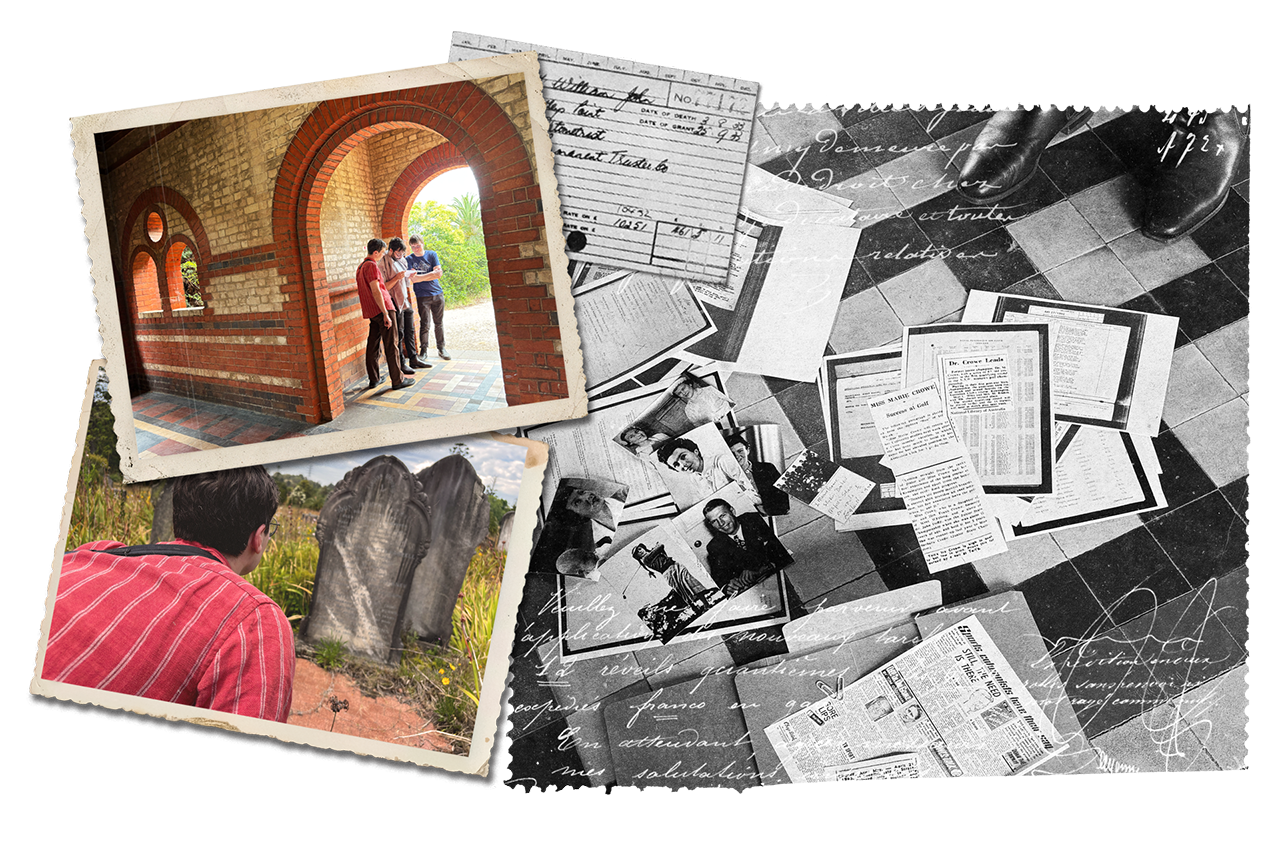
I started with in depth genealogical research, cross checking sources, triangulating conflicting details, and shaping a reliable narrative across four generations, from the family’s first immigration to Australia onward. As I pieced the story together, I translated the research into a location based route and designed the reveal as a guided journey, so participants could uncover the story themselves through staged fragments, printed prompts, and shared interpretation. My aim was to create a shared bonding experience that supports reflection and identity making, and to recreate the feeling of discovery, the slow build, the thrill of finding the right name, and the fascination of decoding handwritten archival documents.
I started with in depth genealogical research, cross checking sources, triangulating conflicting details, and shaping a reliable narrative across four generations, from the family’s first immigration to Australia onward. As I pieced the story together, I translated the research into a location based route and designed the reveal as a guided journey, so participants could uncover the story themselves through staged fragments, printed prompts, and shared interpretation. My aim was to create a shared bonding experience that supports reflection and identity making, and to recreate the feeling of discovery, the slow build, the thrill of finding the right name, and the fascination of decoding handwritten archival documents.
In this project I took a hands on approach across research, writing, experience design, graphic design, production and facilitation on the day.
The experience ran as a one day, four hour journey across six locations, intentionally moving from the familiar to the unknown so the emotional stakes could build as the story reached further back in time. I guided the participants through the route and paced the story reveal through a mix of spoken narration and physical materials delivered at specific moments. Participants received envelopes, prompt cards, old photographs, newspaper cutouts, infographic timelines, and reproduced archival documents, including records that had been top secret and later declassified. Some prompts were reflective, others were puzzle like and collaborative, for example decoding a handwritten document to identify what tattoos a great-great grandfather had, then drawing them onto a silhouette template.
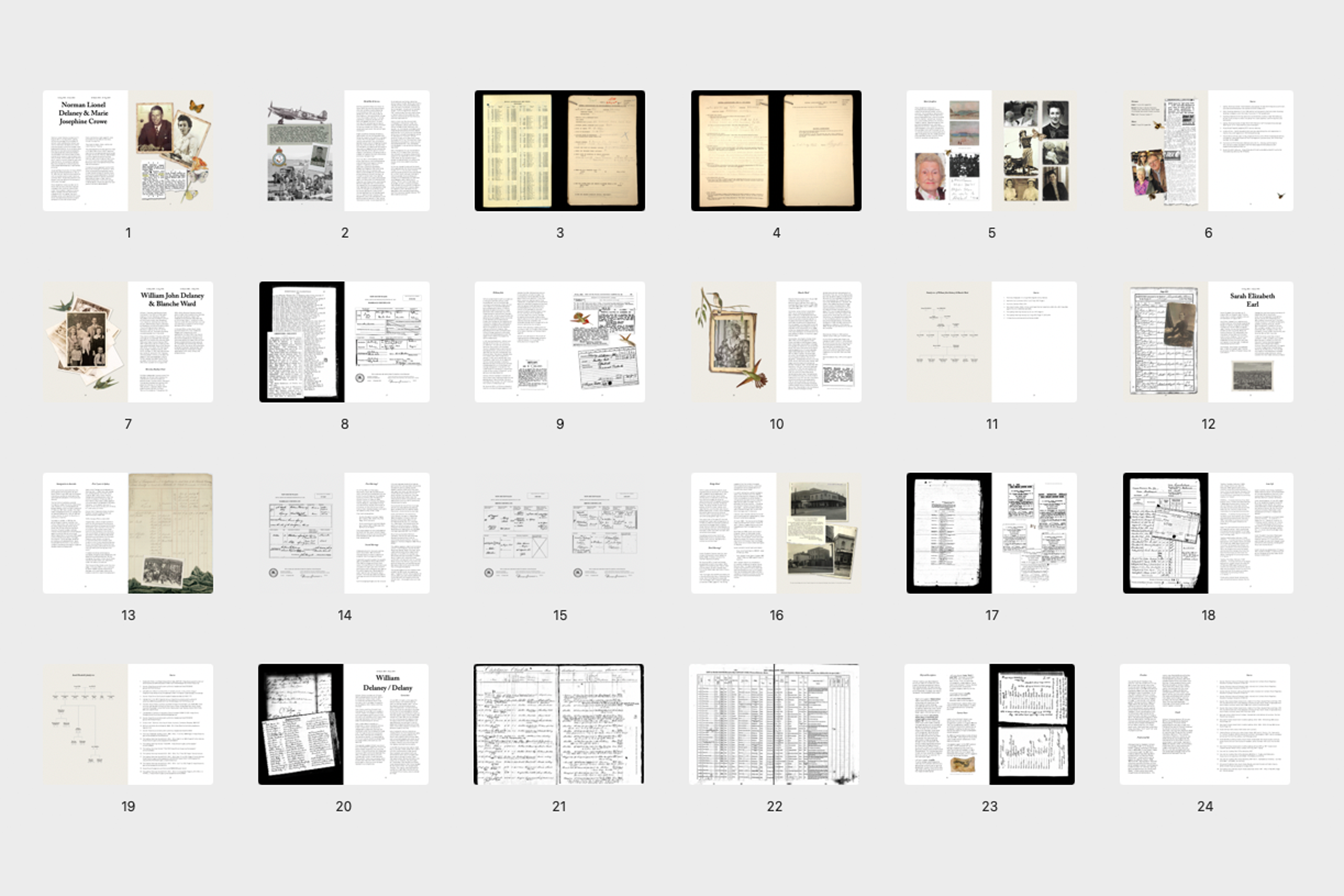
At the end, participants received a custom designed book that brought the full story together through text and images, combining a tactile scrapbook aesthetic with a minimalist editorial layout. It was designed as a keepsake they could return to and share beyond the day.
This project shows how genealogy can be presented as more than dry data, how it can be shaped into a living story that reveals something personal and deeply emotional when it is translated into place, active participation and shared experience. In their feedback, participants said it felt like an adventure, like solving a puzzle or a quest, and that they left feeling more connected to their roots, which were the exact emotions I was designing for.
The experience ran as a one day, four hour journey across six locations, intentionally moving from the familiar to the unknown so the emotional stakes could build as the story reached further back in time. I guided the participants through the route and paced the story reveal through a mix of spoken narration and physical materials delivered at specific moments. Participants received envelopes, prompt cards, old photographs, newspaper cutouts, infographic timelines, and reproduced archival documents, including records that had been top secret and later declassified. Some prompts were reflective, others were puzzle like and collaborative, for example decoding a handwritten document to identify what tattoos a great-great grandfather had, then drawing them onto a silhouette template.
At the end, participants received a custom designed book that brought the full story together through text and images, combining a tactile scrapbook aesthetic with a minimalist editorial layout. It was designed as a keepsake they could return to and share beyond the day.
This project shows how genealogy can be presented as more than dry data, how it can be shaped into a living story that reveals something personal and deeply emotional when it is translated into place, active participation and shared experience. In their feedback, participants said it felt like an adventure, like solving a puzzle or a quest, and that they left feeling more connected to their roots, which were the exact emotions I was designing for.
Inner Child Party: a play-based experiential gathering for a small group of guests, designed as a dreamlike environment where adults could loosen everyday social habits and re-connect with childlike curiosity and wonder.
2025
Experimental social experience
close ↵
The Inner Child Party experience was designed to create a dreamlike atmosphere through sensory shifts and simple interaction mechanics, exploring how adults might behave when a space gives them permission to be less composed, more creative, and slightly strange.
Staged over one evening in an open-plan studio, the experience was built as a sequence of thresholds, cues, and interaction points rather than a fixed program. Guests arrived dressed as younger versions of themselves, crossed a ritualised entry sequence, and moved into a landscape of self-directed experiences combining flavour experimentation, collaborative making, conversation prompts, secret tasks, and social games.
Staged over one evening in an open-plan studio, the experience was built as a sequence of thresholds, cues, and interaction points rather than a fixed program. Guests arrived dressed as younger versions of themselves, crossed a ritualised entry sequence, and moved into a landscape of self-directed experiences combining flavour experimentation, collaborative making, conversation prompts, secret tasks, and social games.
The overall design used threshold moments, ambiguous objects, and low-pressure prompts to make the social space feel both slightly unreal and easy to inhabit, allowing interaction to emerge between participants rather than be formally directed.
In this self-directed project, I led the experience end to end, covering concept development, experience design, creative direction, interaction design, graphic design, set design, prop making, and facilitation. I took a circular approach to the set design, sourcing decoration materials from Sydney’s Reverse Garbage (a creative reuse centre that diverts commercial and industrial waste from landfill) and donating the materials back after the event.
In this self-directed project, I led the experience end to end, covering concept development, experience design, creative direction, interaction design, graphic design, set design, prop making, and facilitation. I took a circular approach to the set design, sourcing decoration materials from Sydney’s Reverse Garbage (a creative reuse centre that diverts commercial and industrial waste from landfill) and donating the materials back after the event.
Pre-Event Activation
A series of invitation emails was sent as a form of pre-event activation. The first letter acted as a soft filter, helping guests decide whether they were willing to show up without the usual social mask. The following messages primed guests for the theme, childhood reflection, and dress prompt, allowing the experience to begin before arrival.
Come as Your Younger Self
Guests were asked to arrive dressed as a younger version of themselves (inspired by an Instagram trend, which became the spark for the whole experience). As a pre-event mechanic, it invited reflection before arrival and later worked as a social equaliser, making it easier for guests to start conversations and share small personal stories.
Crawl Forest Tunnel Entrance
Guests entered by crawling through a tunnel built from tree branches, creating a ritualised threshold into the ‘magic circle’ (the designed boundary where everyday rules are suspended) of the party. The constraint was designed to make adults physically feel smaller and more childlike, resetting them into a more playful state.
Fog + Lasers
After crawling through the tunnel guests stepped into an outdoor space filled with scented fog and soft laser light. This space worked as a sensory buffer between the outside world and the rest of the experience, creating a brief moment of disorientation and wonder.
Secret Missions
Upon entry guests picked up a sealed ‘top secret card’ containing a small mission to complete during the evening. The prompts were designed to quietly spark play and interaction with missions ranged from harmless mischief to gentle social nudges. They gave guests permission to behave slightly outside normal social rules, creating small moments of spontaneous interpersonal play.
The Photo Wall
At arrival, each guest was photographed in their outfit and the Polaroid photo was added to a photo wall beside their pre-printed childhood photo, which had been placed in advance. The intent was to signal belonging and to create a low-effort conversation starter as guests tried to identify each other.
sugar Floss Mixology lab
A self-operated fairy floss station offered a variety of flavoured sugars to mix and experiment with. Guests could spin their own and invent unexpected combinations, turning the activity into a hands-on multisensory experiment.
Taste-Tripping Charcuterie
A charcuterie table featured unusual pairings and mostly sour foods that would not normally appear together. Guests were offered miracle berries, a fruit that temporarily makes sour foods taste sweet. By deliberately disrupting familiar flavour expectations, the station contributed to the overall sensory logic of the evening, where ordinary things behaved in slightly magical ways.
Drawing Room
One room was covered in butcher paper from floor to walls and stocked with drawing materials, creating a quiet space to slow down and make without worrying about skill or outcome. As the night unfolded, guests moved from small doodles to more shared gestures, including tracing each other’s bodies onto the floor, gradually turning the room into a collective record of the group’s presence and imagination.
Whispering Tree
A suspended branch installation held floating glass vessels, each containing a folded conversation prompt, leaning into the dreamlike atmosphere of the event. Positioned as a quieter pause within the gathering, it let guests choose between lighter or more introspective questions and open up at their own pace.
Social Bingo
Guests received bingo cards filled with real childhood facts submitted in advance, from strange habits to oddly specific memories. The game worked as social glue, giving people an easy reason to approach strangers and quickly uncover shared childhood parallels. At the end of the night, the answers were revealed and each guest could share the short story behind their prompt. Several guests said it made talking to new people easier, and somewhat unexpectedly, it became the activity most often named as the favourite.
The Guided Path: a speculative festival entry experience designed for a night-time arts event like Dark Mofo. The concept was developed in a five-day sprint to test AI as a tool for experience visualisation.
2025
Speculative festival entry experience
The Guided Path: a speculative festival entry experience designed for a night-time arts event like Dark Mofo. The concept was developed in a five-day sprint to test AI as a tool for experience visualisation.
2025
Speculative festival entry experience
close ↵
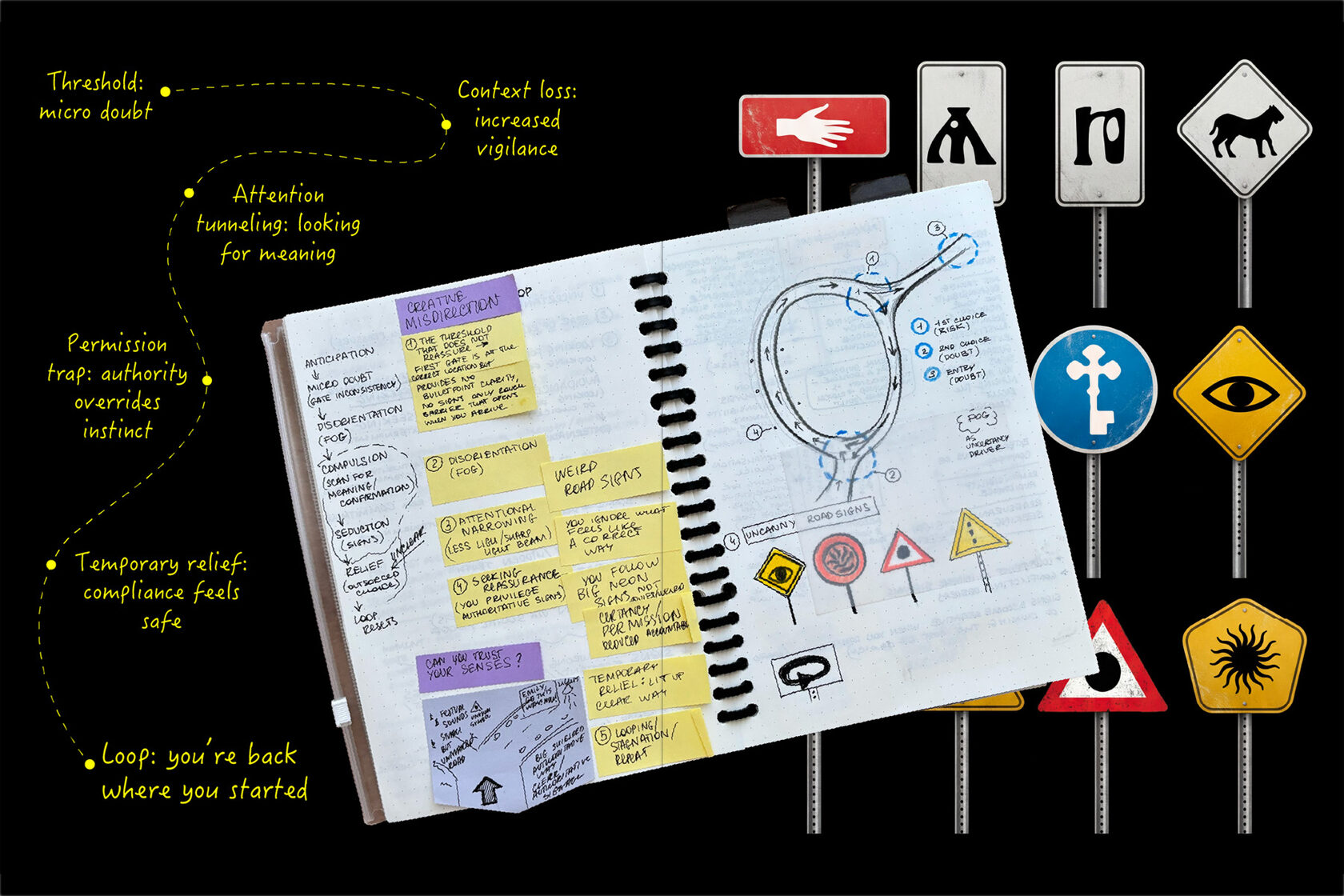
The idea was to turn the festival arrival threshold into a deliberately misleading navigation sequence designed to reveal a familiar behavioural loop: when uncertainty feels hard to tolerate, people start looking for external direction instead of trusting themselves.
The experience is structured as a looping entry sequence in which wayfinding, lighting, and spatial cues become progressively more directive. As uncertainty builds, participants are pushed into a recognisable pattern: scanning for reassurance, assigning meaning to ambiguous signals, and following whatever feels most official or approved. The path offers temporary relief through clarity, but that relief comes at the cost of agency. The loop only breaks when the participant chooses without certainty and accepts responsibility for the choice.
In this self-directed concept, I covered concept development, behavioural framing, experience design, and visual prototyping. The skill I tested here was translating an abstract psychological loop into a legible spatial experience, then communicating that experience quickly using AI-generated environment visuals and first-person video prototypes.
The experience is structured as a looping entry sequence in which wayfinding, lighting, and spatial cues become progressively more directive. As uncertainty builds, participants are pushed into a recognisable pattern: scanning for reassurance, assigning meaning to ambiguous signals, and following whatever feels most official or approved. The path offers temporary relief through clarity, but that relief comes at the cost of agency. The loop only breaks when the participant chooses without certainty and accepts responsibility for the choice.
In this self-directed concept, I covered concept development, behavioural framing, experience design, and visual prototyping. The skill I tested here was translating an abstract psychological loop into a legible spatial experience, then communicating that experience quickly using AI-generated environment visuals and first-person video prototypes.
